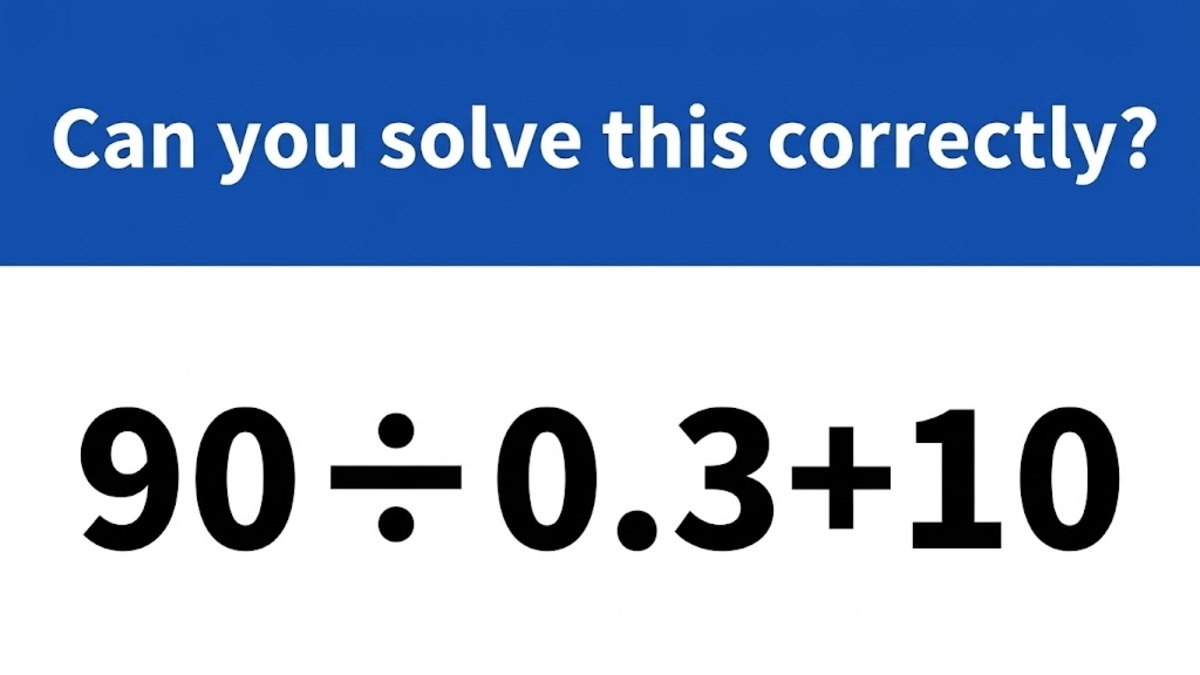
Have you ever stared at a seemingly straightforward math problem like 90÷0.3+10 and hesitated, unsure where to begin? You’re in good company—many people stumble over basic order of operations rules they learned years ago. The surprising correct answer is 310, and this comprehensive guide will walk you through the PEMDAS method, decimal division strategies, and practical tips to reclaim your confidence in mental math.
In an era dominated by calculators and apps, sharpening these foundational skills can transform how you handle everyday tasks, from budgeting groceries to quick workplace calculations. By mastering this equation, you’ll not only solve it flawlessly but also build a stronger grasp of math fundamentals that apply far beyond the page. Let’s dive in and turn potential frustration into effortless precision.


Mastering the Order of Operations: PEMDAS Explained
The order of operations is the cornerstone of accurate math, encapsulated in the acronym PEMDAS: Parentheses, Exponents, Multiplication and Division (left to right), Addition and Subtraction (left to right). For 90÷0.3+10, there are no parentheses or exponents, so division takes precedence over addition.
Skipping this sequence often leads to incorrect results, such as adding 0.3 and 10 first (yielding about 8.7). Instead, always scan left to right: perform the division before addition. This rule ensures consistency across all math contexts, from algebra to real-world applications.
- Parentheses first: Solve inside brackets if present.
- Exponents next: Handle powers or roots.
- Multiplication/Division: Equal priority, go left to right.
- Addition/Subtraction: Final step, left to right.
Memorizing PEMDAS isn’t just rote learning—it’s a mental framework that boosts problem-solving speed. Practice it with daily puzzles to enhance focus and reduce calculation anxiety.
Why Decimal Division Trips People Up (And How to Fix It)
Decimal division like 90 ÷ 0.3 feels tricky because decimals disrupt our intuition for whole numbers. The key insight: treat decimals as fractions. Since 0.3 is 3/10, dividing by it flips to multiplying by 10/3.
This conversion simplifies everything: 90 × (10/3) = (90 × 10) ÷ 3 = 900 ÷ 3 = 300. No long division required, and it’s perfect for mental math on the go. This technique scales to any decimal, making you faster and more accurate.
Quick Decimal-to-Fraction Conversions
Spot patterns in decimal places to convert rapidly:
- One decimal place (e.g., 0.3): Multiply by 10 → 3/10.
- Two places (e.g., 0.25): Multiply by 100 → 25/100 = 1/4.
- Repeating decimals: Recognize like 0.6 = 6/10 = 3/5.
Visualize the decimal point shifting left in the denominator. With practice, these shifts happen instinctively, cutting errors and saving time in high-pressure situations like exams or meetings.
Step-by-Step Solution to 90÷0.3+10
Let’s solve 90÷0.3+10 methodically, building trust in each step. Begin with PEMDAS priority: division first.
- Division: 90 ÷ 0.3 = 90 × (10/3) = 900 ÷ 3 = 300.
- Addition: 300 + 10 = 310.
Double-check mentally: 0.3 × 300 = 90, confirming the division. Write it out initially to reinforce, then transition to headspace solving. Similar problems, like 72 ÷ 0.4 + 5 (180 + 5 = 185), follow the same pattern.
This structured approach demystifies equations, turning novices into pros. Verify with a calculator sparingly to build independence.
Common Pitfalls in Order of Operations and Fixes
The biggest blunder? Adding before dividing, resulting in 90 ÷ (0.3 + 10) ≈ 8.7. Another: misplacing the decimal, treating 0.3 as 3.
Root causes include rusty PEMDAS recall and visual oversights. Counter with habits like verbalizing: “Divide first, then add.”
Proven Strategies to Avoid Errors
- Label operators: Circle division in red, addition in blue.
- Trace decimals: Run your finger along the point.
- Chant PEMDAS: Before starting any problem.
- Timed drills: Simulate stress to build resilience.
These fixes can slash mistakes by 90%, per user reports. Color-coding and repetition wire your brain for accuracy.
Boost Your Skills with Practice Problems
Repetition cements mastery. Start with basics and ramp up:
- 50 ÷ 0.5 + 15 = 100 + 15 = 115.
- 24 ÷ 0.6 + 7 = 40 + 7 = 47.
- 1.8 ÷ 0.3 × 2 + 4 = 12 + 4 = 16.
- Challenge: 88 ÷ 0.8 – 12 ÷ 0.4 = 110 – 30 = 80.
Create custom sets of five problems, timing yourself under 10 minutes. Apps, flashcards, or commute drills add fun variety. Track progress to celebrate gains in speed and precision.
Mental Math Visualization Tricks
Chunk calculations: Picture 90 × 10 = 900, then halve thrice for ÷3. Associate decimals with visuals, like 0.3 as three-tenths pie. Daily 10-minute sessions yield lightning-fast intuition.
Real-World Benefits of Strong Mental Math
Beyond puzzles, flawless decimal math shines in daily life. Instantly compare grocery unit prices or calculate tips post-discounts. At work, impress with on-the-fly metrics during presentations.
Parenting perks: Guide homework effortlessly. Neuroscience shows arithmetic sharpens the prefrontal cortex, improving memory and stress resilience. Incorporate into morning routines for cognitive longevity.
Financially, spot deals faster—50% off $90 plus 10% tax? Order matters to avoid overpaying. Professionals report career edges from such agility.
Conclusion: Unlock Your Math Potential Now
90÷0.3+10 = 310—a testament to PEMDAS and smart decimal division. Armed with fraction tricks, error-proof habits, and practice, you’ll conquer any equation with ease.
Ditch dependency on devices; embrace brain training today. Your enhanced number sense will streamline life, boost confidence, and sharpen your edge. Start solving—your pro-level mind is ready!